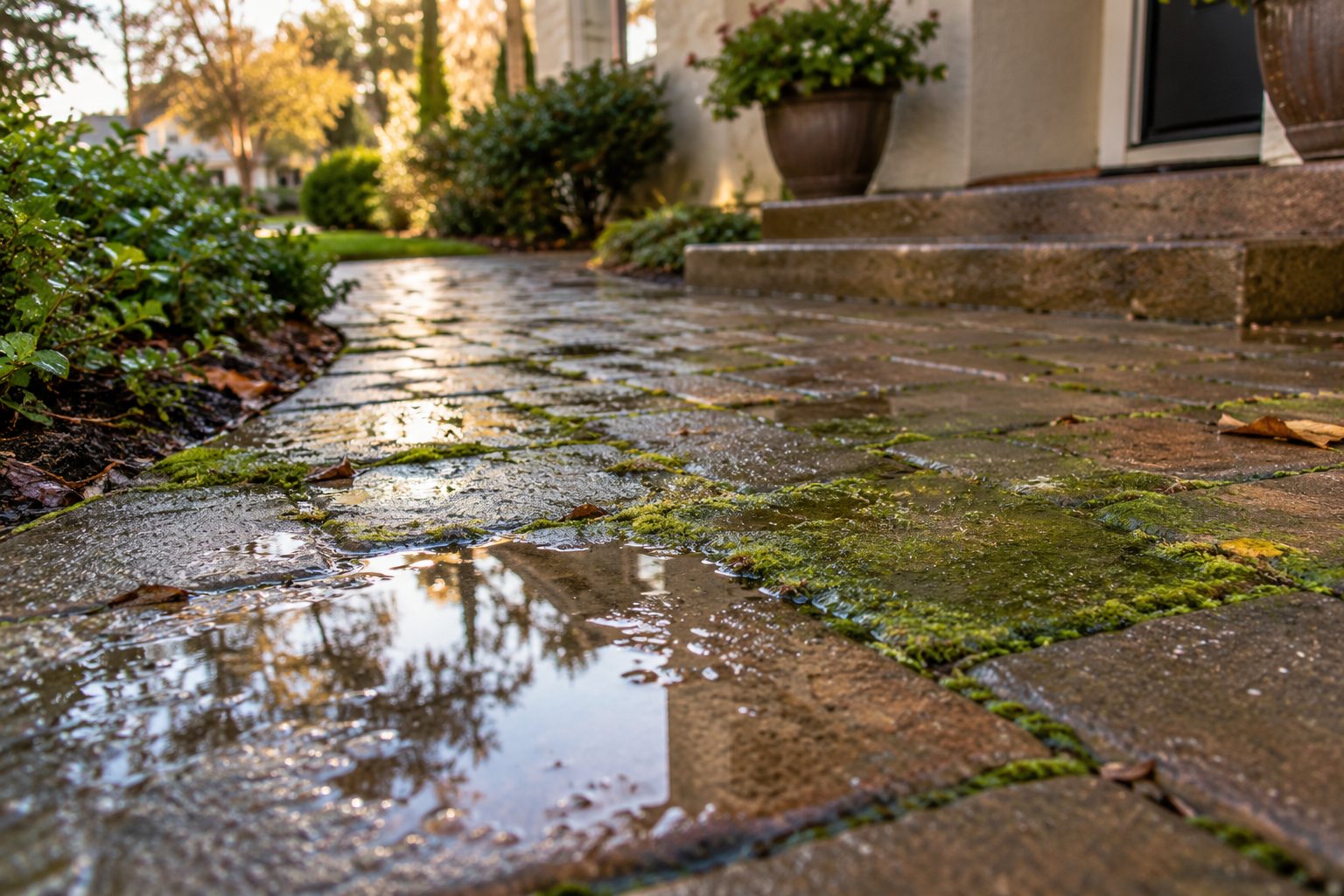
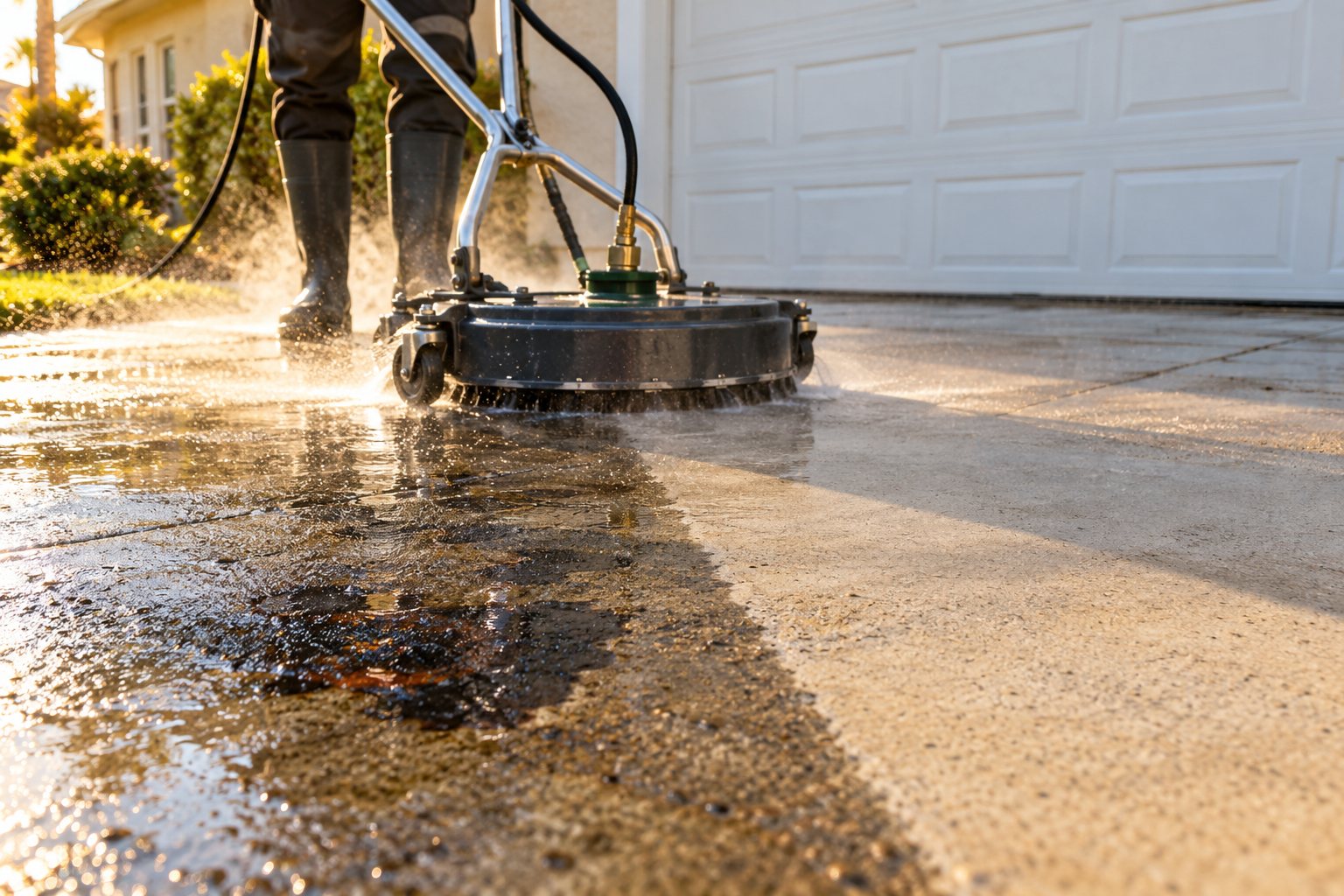
Pressure washing reliably removes everyday driveway grime, dust, pollen film and most fresh tire marks. Oil is different: a new drip often comes out almost completely, but an old stain that has soaked into concrete will usually lighten rather than vanish. Pavers can be cleaned just as well as poured concrete, but they need a gentler technique and attention to the sand between the stones. And whatever comes off the driveway has to be kept out of the storm drain.
What cleaning can and can't remove
Concrete and concrete pavers are porous, so anything that sits on them long enough works its way below the surface. Here is a realistic picture:
| Problem | Concrete slab | Pavers | Realistic result |
|---|---|---|---|
| Dust, dirt, pollen, leaf tannins | Comes off | Comes off | Usually fully removed |
| Fresh oil drips (days to weeks) | Absorbent first, then wash | Absorbent first, then wash | Often removed or nearly invisible |
| Old, deep oil stains | Repeated treatment | Repeated treatment | Lightened; a shadow may remain |
| Tire marks | Detergent and scrubbing | Detergent and scrubbing | Usually fade a lot; heavy marks may ghost |
| Stains that won't budge | Live with the shadow | Swap the stained units | Pavers have the extra option of replacement |
Oil stains: why they're stubborn
Motor oil doesn't just sit on top of concrete; it wicks into the pores. That is why the first step is to pull out as much oil as possible before any water touches it. Guidance from the Portland Cement Association, republished by University of Georgia Extension, says to blot free-standing oil with paper towels or rags and not to wipe, because wiping spreads the stain and drives it deeper. It then recommends covering the spot with an absorbent such as dry cement for at least a day, repeating until no more oil comes up[1].
The Concrete Masonry & Hardscapes Association (CMHA) gives similar advice for pavers: cover penetrated oil with an absorbent like kitty litter, leave it for a day and sweep it up, and expect that deep-set oil stains may need several rounds of stain remover[2]. CMHA also recommends testing any remover on a small, out-of-sight area first[2].
Tire marks
Black tire marks show up where cars turn, park or sit in the sun. They are rubber and road grime pressed into the surface, and they usually respond well to a detergent pre-treatment followed by washing. CMHA's paver guidance is simple: scrub the black area with water, detergent and scouring powder[2]. Older or heavily baked-on marks can leave a faint outline, especially on lighter-colored concrete.
Concrete vs. pavers
Poured concrete
A slab is one continuous surface, so it tolerates an even, overlapping cleaning pattern. The main goals are a uniform finish (no stripes or blotchy patches) and pre-treating oil and tire marks so the wash doesn't just push grime around.
Interlocking pavers
Pavers are individual units set in sand, and that sand is part of what holds them in place. CMHA notes that pressure washers used on pavers typically run between 1,000 and 4,000 psi, recommends a wide, low-angle spray pattern to avoid washing sand out of the joints, and warns that a narrow spray can dislodge joint sand[2]. After a deep clean, it is common to check the joints and top them up with sand where needed.
Pavers also have one big advantage: if a stain truly won't come out, CMHA suggests replacing the stained units with the same type of paver[2]. New pieces may look slightly different at first, but that difference tends to fade over time[2].
Handling the runoff properly
Driveway wash water carries oil, rubber dust, dirt and whatever cleaner was used. In Sacramento County, water that enters a storm drain is carried in pipes to local creeks and rivers without treatment[3]. That is why the Sacramento-area best management practices guide for pressure washing and surface cleaning says wash water may not go into storm drains, gutters, streets or ditches, and points out that nearly all outdoor drains are storm drains[4].
The same guide lays out what responsible cleaning looks like[4]:
- Sweep first and use dry spot-cleaning where possible, so loose debris never gets washed downstream.
- Pre-clean oily spots with absorbent before wet washing, and dispose of oily absorbent properly.
- Block or protect nearby storm drains before starting.
- Send wash water to a landscaped area only with the owner's approval, only if it isn't hazardous, and only if the soil can absorb it without puddling or harming plants.
- Don't leave wash water to evaporate on pavement, where the residue can wash into drains with the next rain.
- Use water-regulating nozzles and avoid harsh products such as muriatic acid, sodium hydroxide and bleach.
When you hire anyone to clean your driveway, ask how they handle runoff. For more on this topic, see our guide to eco-friendly exterior cleaning and storm drains.
Keeping the driveway cleaner between visits
- Blot fresh oil drips right away and cover them with absorbent.
- Put a drip pan under any vehicle that leaks.
- Clean the paths and patio at the same time so the whole entry matches; see walkway and patio cleaning.
How LORS Cleaning handles driveways
LORS Cleaning pressure washes concrete and paver driveways for homes and businesses across the Sacramento region, within 100 miles of the city. We pre-treat oil and tire marks, use eco-safe biodegradable products, and tell you honestly which stains will lift and which will only lighten. Every job starts with a free, exact estimate with no hidden fees, and if something isn't right, tell us within 24 hours and we'll come back and fix it free.
Planning a bigger refresh? Read soft washing vs. pressure washing to see why siding and stucco get a different method, or curb appeal cleaning before selling. Local customers can also visit our Sacramento service page.
Quick answers
Can pressure washing remove old oil stains completely?
Not always. Fresh drips often come out, but oil that has soaked into concrete for a long time usually lightens and may leave a faint shadow. On pavers, badly stained units can be replaced.
Is pressure washing safe for pavers?
Yes, with the right technique. A wide, low-angle spray helps keep sand in the joints, and joints can be topped up with sand after cleaning if needed.
Can driveway wash water go down the storm drain?
No. In the Sacramento area, wash water must be kept out of storm drains, gutters and streets, because storm drains carry water to creeks and rivers without treatment.
Sources
- University of Georgia Cooperative Extension (citing the Portland Cement Association). Remove Stains From Oil (n.d.). https://site.extension.uga.edu/textiles/wp-json/wp/v2/pages/116
- Concrete Masonry & Hardscapes Association. Cleaning, Sealing and Joint Sand Stabilization of Interlocking Concrete Pavement, PAV-TEC-005-22 (2022). https://www.cmha.org/resource/pav-tec-005/
- Sacramento County Department of Water Resources. Stormwater Quality & Pollution Prevention (n.d.). https://waterresources.saccounty.gov/us/en/drainage/stormwater-quality.html
- Sacramento Stormwater Quality Partnership / Sacramento County EMD. Preventing Stormwater Pollution: BMPs for Pressure Washing and Surface Cleaning in the Greater Sacramento Area (2020). https://emd.saccounty.gov/EH/Documents/bmps_mobile_pressure_washer_-_surface_cleaner%202020.pdf