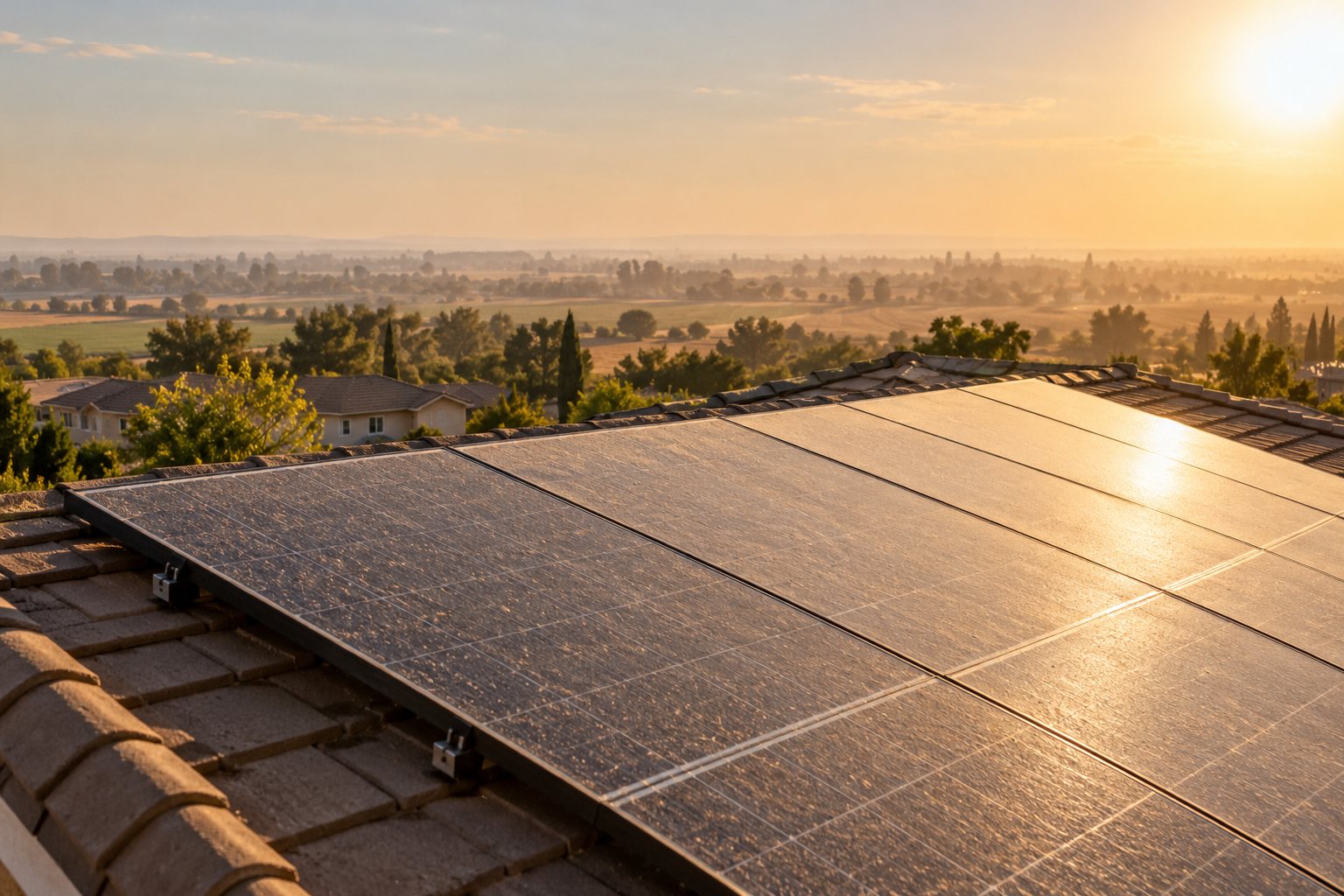
Short answer: sometimes. For most California homes, light dust costs a few percent of output, and research suggests routine cleaning doesn't always pay for itself. Cleaning clearly helps when panels have bird droppings, sticky pollen or heavy grime, when they sit nearly flat, or when they're close to a dust source like a farm field or busy road. Here's what the studies actually found, and how to decide for your own system.
What "soiling" is and how much it costs you
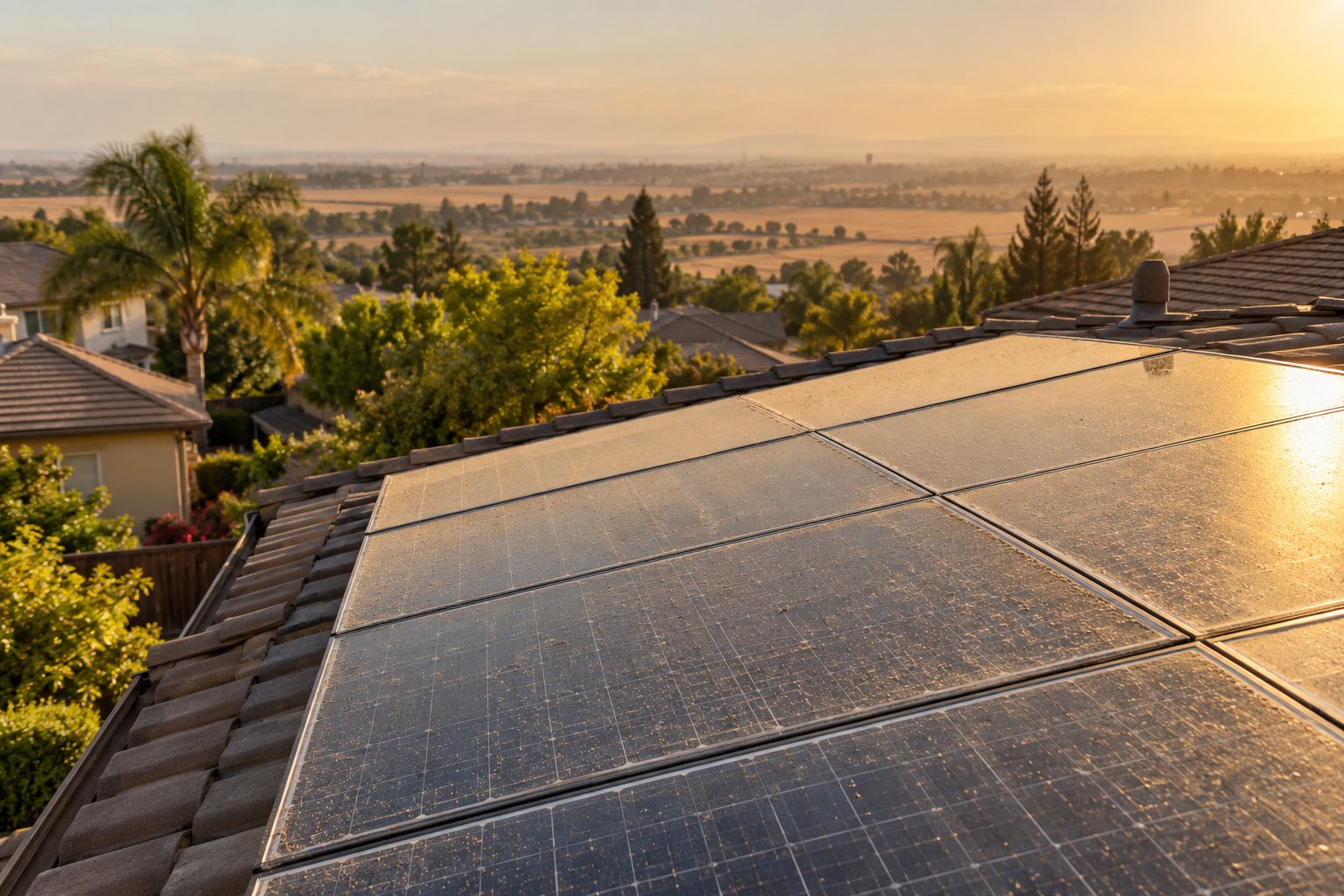
Soiling is the industry term for anything that settles on the glass and blocks sunlight: dust, pollen, soot, ash, leaves and bird droppings. Less light reaching the cells means less electricity. Researchers at the National Renewable Energy Laboratory (NREL) estimated that soiling can reduce PV system performance by roughly 4% to 10% or more, depending on the site[1]. They also noted that humidity and dew cycles seem to make soiling worse, and that dust left in place longer gets harder to remove[1].
That range is wide because soiling depends heavily on where you live, how your panels are tilted, and what's upwind of them.
The California study: smaller losses than you might expect
The best-known California data comes from engineers at UC San Diego. Felipe Mejia and Jan Kleissl analyzed 186 residential and commercial solar sites, from the Bay Area to the Mexican border, during the long dry summer of 2010[2][3]. Key findings:
- Panels that went 145 days without rain or cleaning lost only about 7.4% of their efficiency, an average of roughly 0.05% per day[2].
- For a typical 5 kW home system, washing halfway through that summer would have recovered only a small amount of electricity before the rains returned[2].
- Panels tilted at less than 5 degrees lost more, because dirt doesn't slide off nearly flat glass[2].
- Regional differences weren't statistically significant, but sites in the Los Angeles basin and the Central Valley had dirtier panels[2].
- Sites directly downwind of a highway, factory or farm field may collect enough dirt to justify cleaning[2].
The researchers' takeaway was blunt: for most homeowners, paying for routine cleaning of lightly dusty panels won't pay for itself[2]. That's an honest starting point, and we'd rather you hear it from us.
Why rain doesn't fully clean your panels
Many people assume winter rain resets everything. For loose dust, it mostly does. One manufacturer's cleaning guidelines say rainfall should be enough to remove lighter soiling at many installations[4]. But rain is far less effective on anything that sticks.
A 2023 NREL-led study of five solar plants in North Carolina, a much rainier place than Sacramento, found that pollen cut output by as much as 15% at the peak of pollen season[5]. Even frequent rain didn't bring performance back to clean levels after the season ended, and wet-brush cleaning improved performance by 5% to 11%[5]. As NREL's Matthew Muller put it, "regular rainfall is not sufficient to assume that solar plants are fully cleaned in certain environments"[5].
In the Central Valley the problem is compounded by timing. Our dry season runs for months, right through the sunniest, highest-production part of the year, so any grime that builds up in spring and summer stays put when your panels are working hardest.
Bird droppings are the clear exception
Dust spreads thinly across the glass. Bird droppings don't: they form dense spots that block nearly all light where they land, and rain doesn't wash them away. The UC San Diego researchers specifically said heavy droppings should be cleaned off[2]. If you see droppings on your array, especially below a roofline where birds perch, that's a good reason to clean regardless of what the averages say.
When cleaning is most likely to help
- Visible bird droppings, leaf debris or sticky residue that rain hasn't moved
- Low-tilt or nearly flat panels, common on patio covers, carports and commercial roofs
- Homes near farm fields, dirt roads, freeways or construction
- After a heavy spring pollen season or after wildfire smoke and ash
- Late in a long dry summer, before the peak months are over
- Your monitoring app shows output dropping compared with the same sunny days last year
If none of these apply and your panels just look a little dusty, it's reasonable to wait for the rain. We'll tell you that during your estimate.
How panels should be cleaned
Cleaning done wrong can do more harm than dirt. Module manufacturers publish cleaning rules, and they're stricter than most people expect. First Solar's guidelines, for example, cap water pressure at the nozzle, forbid spraying pressurized water at junction boxes, edge seals and connectors, prohibit abrasive cleaners and degreasers, and warn against water much hotter or colder than the panel surface[4]. They also restrict hard water on some modules[4], which matters in parts of the Sacramento region where mineral spots are common.
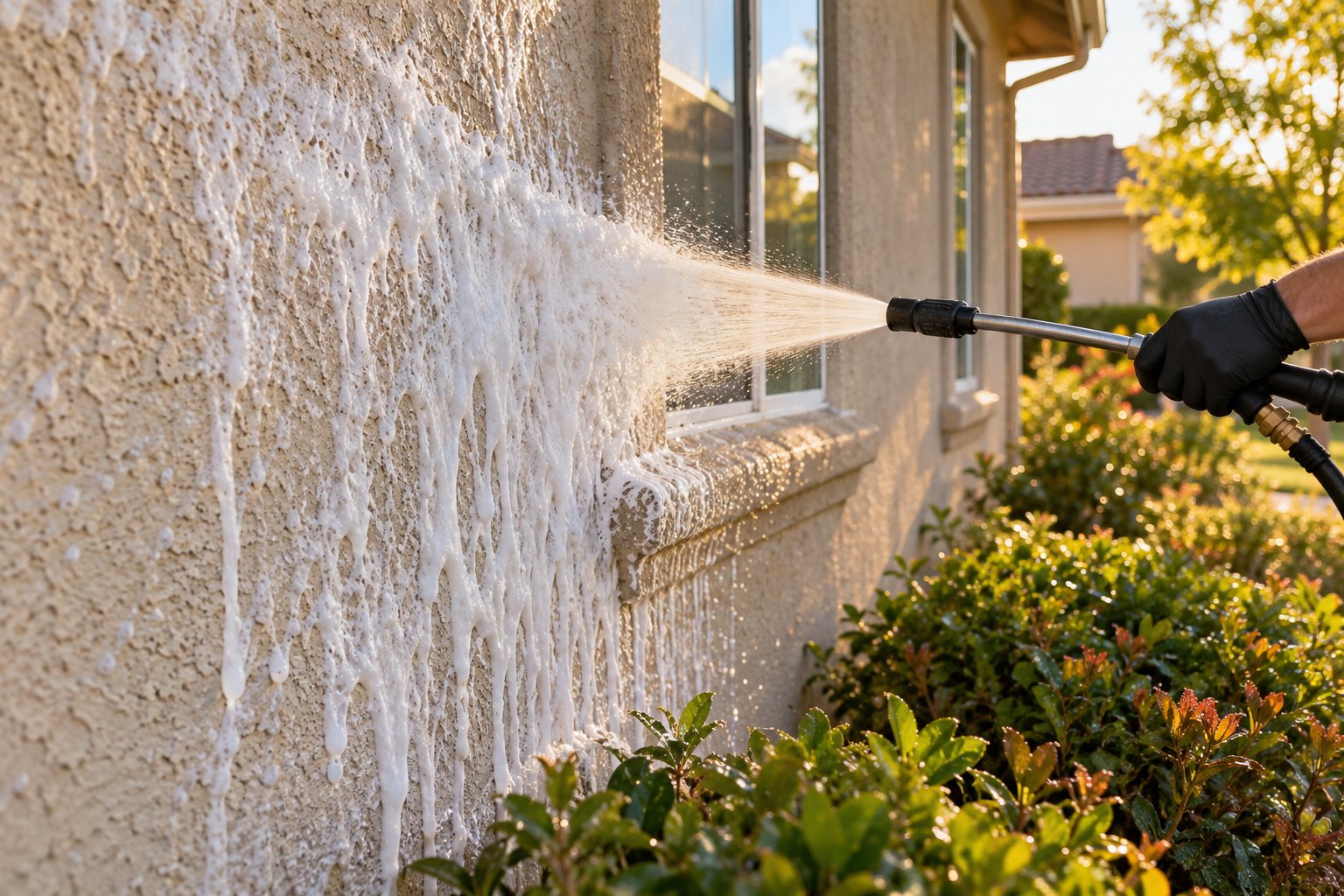
At LORS Cleaning we follow manufacturer guidance: no high-pressure spray, no harsh chemicals, and soft, non-abrasive tools with eco-safe biodegradable products. Always check your own panel and warranty documents, and don't climb onto a roof yourself to scrub panels.
The bottom line
Cleaning solar panels helps, but how much depends on your site. Light dust on well-tilted panels costs a few percent and rain handles a lot of it. Droppings, pollen, ash, low tilt and nearby dust sources change the picture. For timing advice, see how often to clean solar panels in the Central Valley and our guide to cleaning up after wildfire smoke and pollen. If you're in the Sacramento area or nearby, we'll give you a free, exact estimate with no hidden fees, and an honest opinion on whether your panels need it yet.
Quick answers
Will rain clean my solar panels?
Rain removes much of the loose dust, but research shows it doesn't fully remove sticky soiling like pollen, and it won't wash off bird droppings. In the Central Valley, months without rain also mean grime builds during peak production season.
How much power do dirty solar panels lose?
It varies by site. A UC San Diego study of California systems found about 7.4% lost after 145 dry days, while NREL estimates soiling losses of roughly 4% to 10% or more depending on location.
Do you use a pressure washer on solar panels?
No. We follow manufacturer guidance: no high-pressure spray and no harsh chemicals, using soft, non-abrasive tools and eco-safe biodegradable products.
Sources
- Simpson L, Muller M, Deceglie M, Miller D, Moutinho H (NREL). The Modeling of the Effects of Soiling, Its Mechanisms, and the Corresponding Abrasion. PV Module Reliability Workshop (2016). https://nrel.gov/docs/fy16osti/66822.pdf
- UC San Diego. Cleaning Solar Panels Often Not Worth the Cost, Engineers at UC San Diego Find (2013). https://today.ucsd.edu/story/cleaning_solar_panels_often_not_worth_the_cost_engineers_at_uc_san_diego_fi
- Mejia FA, Kleissl J. Soiling losses for solar photovoltaic systems in California. Solar Energy 95:357-363 (2013). https://escholarship.org/uc/item/5kd297nm
- First Solar. FS-Series PV Module Cleaning Guidelines, PD-5-804 Rev 3.4 (2017). https://firstsolar.com/-/media/First-Solar/Technical-Documents/Series-4-Application-Note/Module-Cleaning-Guidelines.ashx
- National Renewable Energy Laboratory. NREL Research Finds Rain Not Enough To Wash Pollen From Solar Panels (2023). https://nrel.gov/news/program/2023/nrel-research-finds-rain-not-enough-to-wash-pollen-from-solar-panels.html