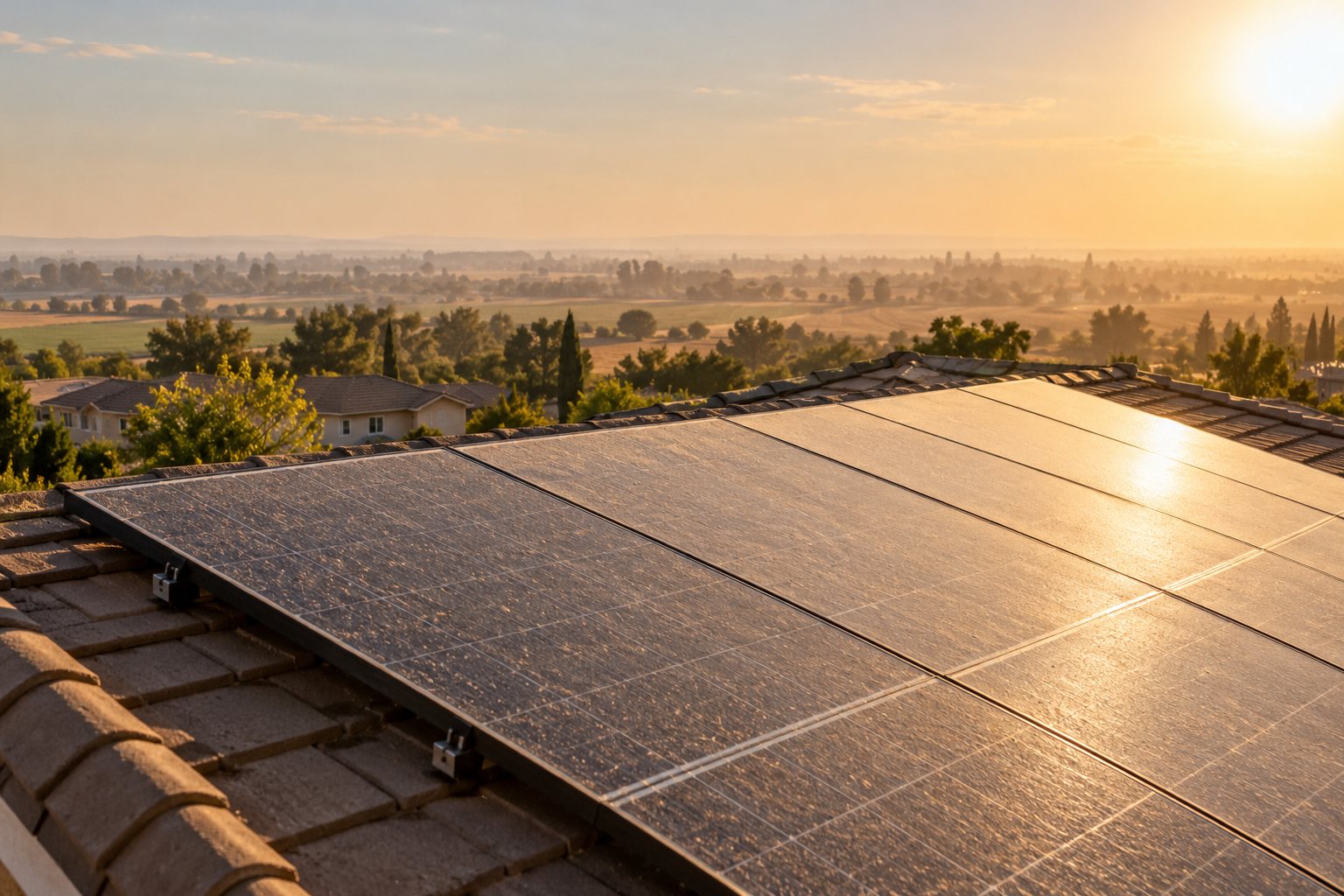
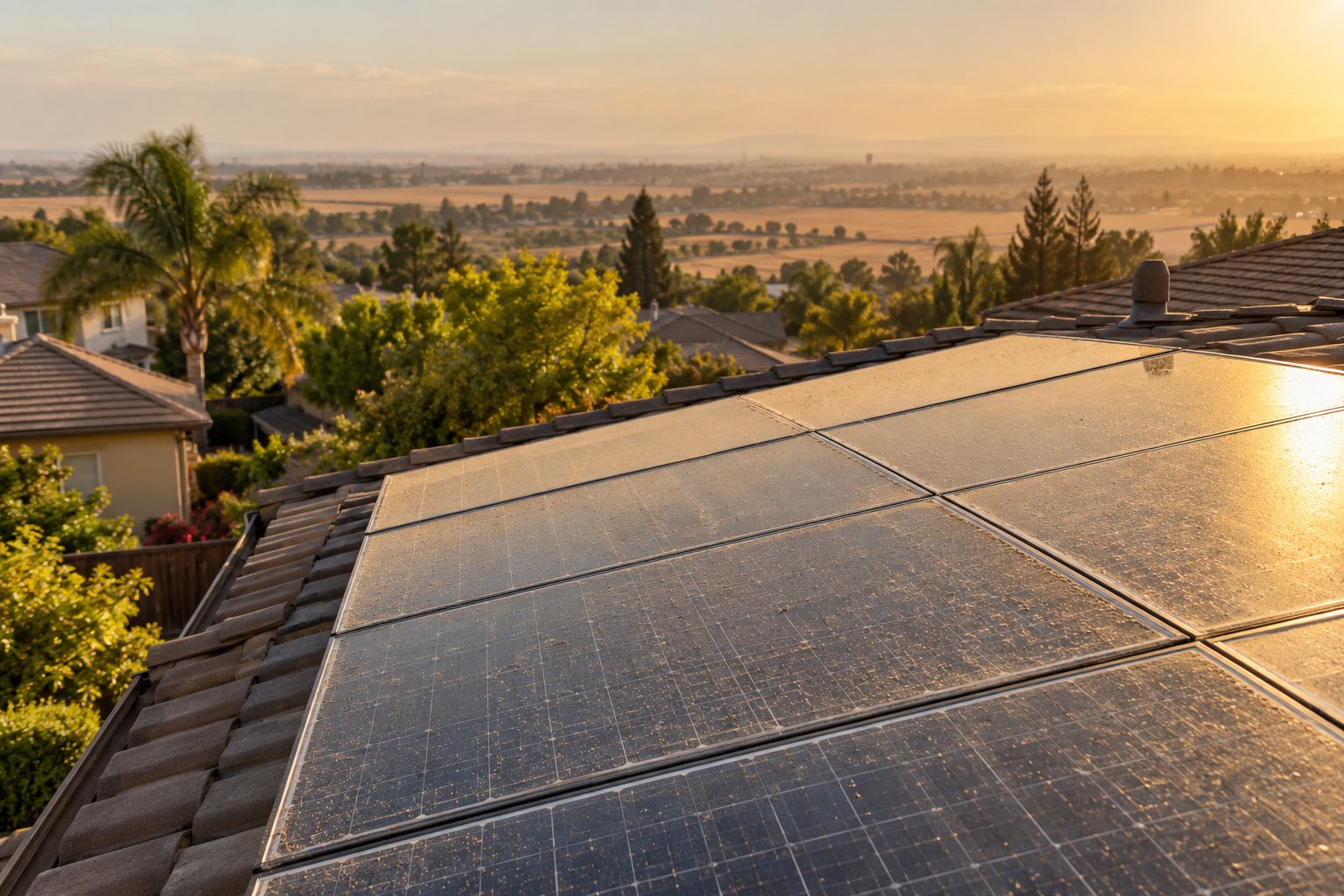
For most rooftop systems in the Central Valley, plan on a check every spring and late summer, and a cleaning once or twice a year: usually late in the dry season, after harvest dust or wildfire ash, and any time bird droppings show up. Panels that sit flat, sit downwind of a farm field, or show a drop in output on clear days may need more. Let your monitoring data set the schedule.
If you want the bigger question of whether cleaning pays off at all, read our research summary, Solar Panel Cleaning: Does It Actually Help? This guide is about timing: when Valley conditions call for a wash, and how to do it without voiding your warranty.
Why the Central Valley is different
Rain rinses panels naturally in winter. From roughly May through October there's little or none, so dust just keeps building up. In a UC San Diego study of 186 California solar sites, panels went 145 days of summer drought without rain or cleaning. Over that stretch they lost about 7.4% of their efficiency, a little under 0.05% per day[1]. That's a modest loss, and it's why a fixed monthly cleaning schedule rarely makes sense here.
The same study found exceptions that matter in the Valley[1]:
- Farm dust: Central Valley sites had dirtier panels. Panels directly next to and downwind of an agricultural field could collect enough dirt to be worth cleaning.
- Tilt angle: Panels mounted at less than 5 degrees lost more efficiency, because dirt doesn't slide off a nearly flat surface. That includes many low-slope commercial roofs and patio covers.
- Bird droppings: Rain doesn't wash them away, and they block light, so clean them off whenever they appear.
Southern California Edison's homeowner guidance suggests cleaning at least twice a year, and more often near freeways, industrial sites or in windy areas[2]. In our region that describes homes along I-5 and Highway 99, near orchards and row crops, and anywhere the afternoon wind kicks up dust.
A practical schedule for Valley homes
| Situation | Suggested approach |
|---|---|
| Typical pitched roof in town, no nearby fields | Inspect in spring and late summer; clean once a year, near the end of the dry season |
| Near orchards, row crops, dirt roads or a busy freeway | Clean about twice a year, including after harvest or heavy field work nearby |
| Low-tilt panels (under about 5 degrees) | Check more often; dust and residue build up faster and don't run off |
| After a wildfire ash event | Wait until the air clears, then rinse gently |
| Bird droppings or heavy pollen residue | Spot-clean promptly; don't wait for rain |
Wildfire smoke vs. wildfire ash
Smoke and ash cause two different problems. During the September 2020 fires, researchers from the National Center for Atmospheric Research found that heavy smoke cut California solar production by 10 to 30% between noon and 4 p.m. compared with the same days in earlier years[3]. That loss came from smoke blocking sunlight. Cleaning won't fix it. Output comes back as the air clears.
Ash that settles on your panels is different. It stays there until rain or a rinse removes it. Don't rush to clean during a smoke event. Once air quality improves, follow EPA ash guidance: don't use leaf blowers or anything else that puts ash into the air, mist surfaces to keep dust down, use as little water as you can, avoid washing ash into storm drains, and wear a snug, two-strap N95 or P100 respirator, not a surgical mask[4]. For siding, windows and patios after fire season, see cleaning your home's exterior after wildfire smoke and pollen.
Use your monitoring app to decide
Most systems include an inverter app or online portal. It's the best cleaning signal you have. SCE notes that a significant drop in performance during clear weather may point to a problem[2]. A simple routine:
- Pick two or three clear, similar days, a few weeks apart, and compare daily production.
- Compare against the same weeks last year, if your app keeps history.
- If output on clear days has slipped and you can see a film, droppings or ash on the glass, a cleaning is likely worthwhile.
- If output drops but the panels look clean, call your installer. New shade from tree growth, a cracked panel or an inverter fault won't be fixed by washing[2].
How to clean safely (and protect your warranty)
Manufacturer instructions matter here. Qcells' current North American installation manual says damage caused by cleaning, or by the tools or cleaning agents used, is not covered by the module's product and performance warranty. It also says to avoid abrasive materials, not to scratch dirt off, and to clean only modules that have cooled down[5]. SCE warns that harsh chemical cleaners may damage panels and void the warranty[2].
- No pressure washer. High-pressure spray can damage panel surfaces, seals and frames. Use low-pressure water only.
- No harsh chemicals or abrasives. Use plain water or a product your panel maker approves, and a soft, non-abrasive tool.
- Clean when panels are cool. Early morning works best in a Valley summer. Cold water on hot glass is a bad idea.
- Stay off the roof unless you're trained and equipped. SCE advises against going up without proper safety equipment or training, and suggests rinsing from the ground with a hose instead[2].
- Check your manual and contract. Panel brands differ. If your system is leased or under a power purchase agreement, maintenance may already be included[2].
If you'd rather not climb, LORS Cleaning cleans solar panels across the Sacramento region and the Central Valley. We follow manufacturer guidance, use no high-pressure spray and no harsh chemicals, and use eco-safe, biodegradable products. Pair it with window cleaning or a soft wash. Ask for a free, exact estimate, with no hidden fees. Serving Stockton, Davis, Yuba City and everywhere within 100 miles of Sacramento.
Quick answers
Do I need to clean my solar panels every month in the Valley?
Usually not. Research on California sites found summer dust losses were modest, so most homes need one or two cleanings a year. Panels near farm fields, at a very low tilt, or with bird droppings may need more.
Can I use a pressure washer on solar panels?
No. Use low-pressure water and soft, non-abrasive tools. Manufacturers such as Qcells say damage caused by cleaning isn't covered by the panel warranty.
Should I clean my panels during wildfire smoke?
No, wait until the air clears. Smoke lowers output by blocking sunlight, which cleaning can't fix. Rinse any settled ash gently afterward, without blowers, and keep the runoff out of storm drains.
Sources
- UC San Diego. Cleaning Solar Panels Often Not Worth the Cost, Engineers at UC San Diego Find (2013). https://today.ucsd.edu/story/cleaning_solar_panels_often_not_worth_the_cost_engineers_at_uc_san_diego_fi
- Southern California Edison. Solar Series: Tips on Maintaining a High-Performance Solar Energy System (2020). https://www.sce.com/sites/default/files/inline-files/Solar%20Maintenance%20Fact%20Sheet%201%20(1).pdf
- NCAR/UCAR News. California wildfire smoke dimmed solar energy in 2020 (2022). https://news.ucar.edu/132875/california-wildfire-smoke-dimmed-solar-energy-2020
- U.S. EPA. Wildfire Smoke Factsheet: Protect Yourself from Ash, EPA-452/F-18-004 (2018), hosted by Yolo County. https://yolocounty.gov/home/showpublisheddocument/66152/637369021318070000
- Qcells. Installation Manual, Q.TRON M Solar Modules, North America (2025). https://solartown.com/content/Qcells_Installation_Manual_Q.TRON_M.pdf