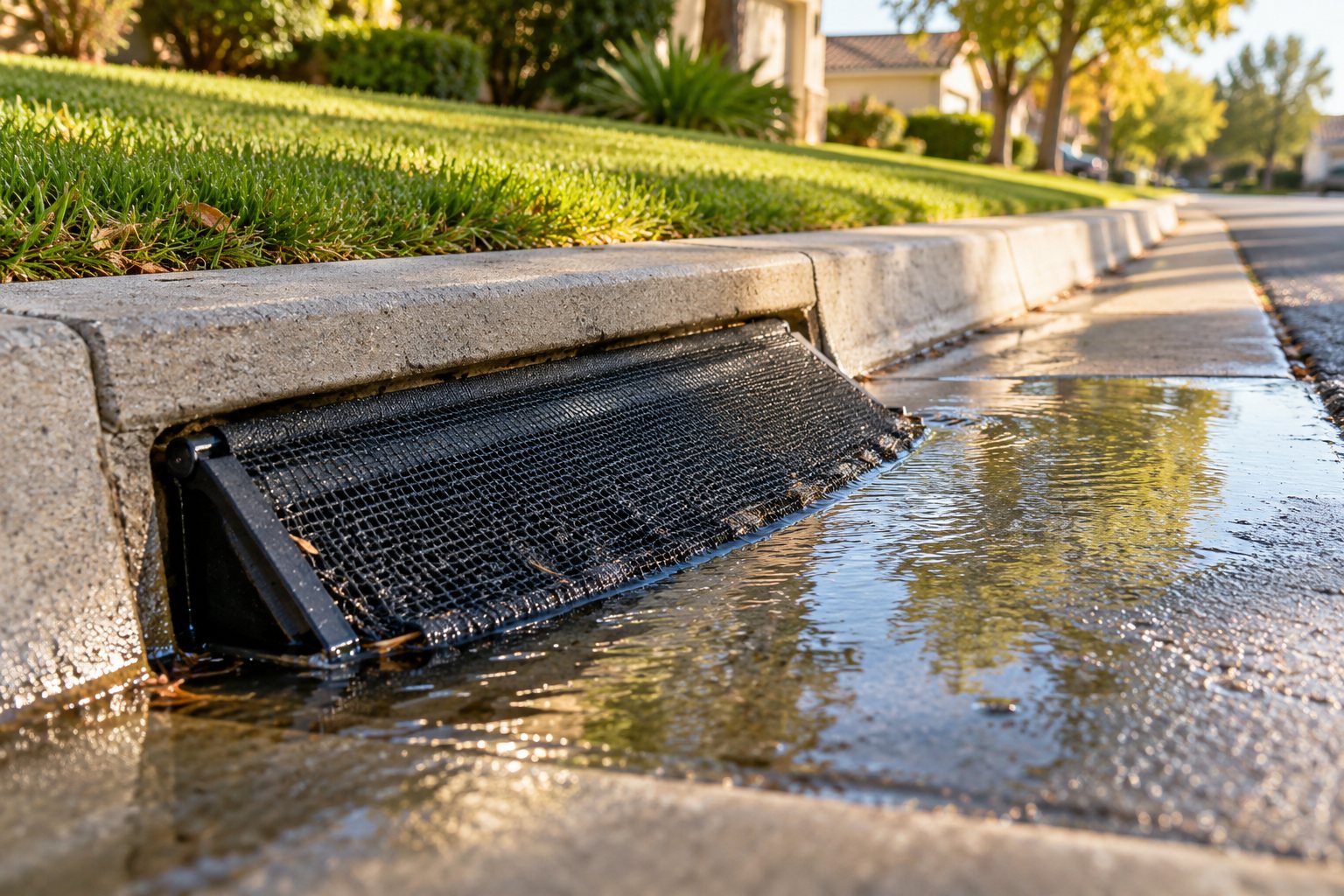
Wash water from pressure washing a driveway, patio or house should never run into a storm drain. In the Sacramento region, storm drains carry water straight to local creeks and rivers without treatment, so anything that washes off your property, like oil, dirt, soap and debris, ends up in the water. The fix is simple: sweep first, use as little water and cleaner as possible, block the drains, and send wash water to landscaping or another approved place.
Why storm drains matter more than most people think
Many people assume the grate at the curb leads to a treatment plant. It doesn't. The U.S. Environmental Protection Agency explains that runoff picks up fertilizer, oil, pesticides, dirt, bacteria and other pollutants and flows through storm drains and ditches, untreated, to streams, rivers, lakes and the ocean[1]. Sacramento County says the same about our area: runoff flows through gutters and drains and is then carried in pipes to local creeks and rivers without treatment[2].
Sacramento County works with the cities of Sacramento, Citrus Heights, Elk Grove, Folsom, Galt and Rancho Cordova through the Sacramento Stormwater Quality Partnership to reduce this pollution, with public education as one of its shared goals[2]. Pressure washing is one of the activities their guidance covers directly.
What the local rules say about pressure washing
Sacramento County's stormwater program is clear: wastewater from pressure washing must not enter a storm drain. Before you start, cover the drains or block the path to them[3]. With the property owner's permission, the water can go into a sanitary sewer cleanout. In some cases it can go onto a landscaped area, as long as it doesn't overflow, carry hazardous substances, or create a nuisance[3].
The Greater Sacramento Area guide BMPs for Pressure Washing and Surface Cleaning (2020) adds detail. It lists two things that are prohibited under all circumstances[4]:
- Discharging wastewater to the storm drain system or any natural water body.
- Letting wastewater evaporate on paved surfaces, where the leftover residue just washes away in the next rain.
Sending water to the sanitary sewer in the Regional San service area also needs Regional San approval and has to follow its Sewer Use Ordinance[4]. For most homeowners and small jobs, the practical takeaway is to keep wash water on your property and out of the gutter.
These local rules sit inside a larger system. California's State Water Board and the Regional Water Boards carry out and enforce the Municipal Storm Water Program, which requires local stormwater systems to reduce the pollutants they discharge[5]. City and county rules on outdoor washing are how that requirement plays out on your driveway.
Best management practices for exterior cleaning
The California Stormwater BMP Handbook's surface-cleaning fact sheet lays out a four-step approach: do dry cleanup before washing, wash without soaps and solvents when you can, keep polluted water out of storm drains, and dispose of wastewater properly and legally[6]. Here is how that works in practice:
- Plan the job. Find nearby storm drains and the low spots where water will collect. The Sacramento guide recommends choosing the collection area and disposal option before any water is used[4].
- Sweep and spot-clean first. Pre-sweeping and dry spot cleaning keep leaves, dirt and debris out of the wash water entirely[4].
- Treat oil stains with absorbent. On driveways and parking areas, pick up oil with absorbent before washing[6]. The Sacramento guide also suggests placing an oil absorbent pad on collected wash water and disposing of used pads as hazardous waste[4].
- Block and contain. Use drain covers, berms or booms so runoff can't reach the gutter, then collect water with a wet/dry vacuum or pump[4].
- Dispose properly. Send collected water to landscaping (with the owner's approval, and only if the soil can absorb it all) or to an approved sewer connection[3].
- Finish clean. Collect the final rinse and sweep up any remaining residue[4].
Biodegradable products: helpful, not a free pass
Choosing gentler products makes a real difference. The Sacramento BMP guide recommends using less toxic cleaners[4], and Sacramento County's River-Friendly car washing guidance suggests products labeled "biodegradable," noting that soapy wash water can harm fish and other aquatic life in local creeks and rivers[7].
But "biodegradable" doesn't mean a product is safe to put in a storm drain. Soapy water still has to be contained, and the state handbook's first choice is to wash without soap at all when the surface allows it[6]. That's why we use eco-safe, biodegradable products and keep the wash water out of the gutter.
Using less water
Less water means less runoff to manage. The Sacramento guide recommends minimizing water use with regulating nozzles or high-pressure systems[4]. Sweeping first also cuts water use, because you aren't using the hose to push debris around. For siding and stucco, low-pressure soft washing lets the cleaning solution do the work instead of large volumes of water. See soft washing vs. pressure washing for how the two methods compare.
| Do | Don't |
|---|---|
| Sweep and spot-clean before washing | Hose debris into the gutter |
| Block or cover nearby storm drains | Let wash water run down the street |
| Absorb oil before washing driveways | Wash oil stains straight into the drain |
| Direct water to landscaping or an approved sewer connection | Leave wash water to evaporate on pavement |
| Use biodegradable products, and no soap when possible | Assume "biodegradable" makes runoff harmless |
How LORS Cleaning handles runoff
LORS Cleaning uses eco-safe, biodegradable products on every job, from driveway pressure washing and walkway and patio cleaning to whole-house exterior washing. On siding and stucco we use low-pressure soft washing where high pressure could cause damage. For solar panels we follow manufacturer guidance, with no high-pressure spray and no harsh chemicals. We're licensed and insured, and if something isn't right, tell us within 24 hours and we'll come back and fix it free.
We serve Sacramento and everywhere within 100 miles, including Sacramento, Elk Grove and Folsom. Ask for a free, exact estimate, with no hidden fees.
Quick answers
Can pressure washing water go into the storm drain in Sacramento?
No. Sacramento County guidance says pressure washing wastewater must not enter a storm drain. Block the drains and send water to landscaping or an approved sewer connection.
Are biodegradable cleaners safe to rinse into the gutter?
No. Biodegradable products are a better choice, but soapy wash water should still be contained and kept out of storm drains.
Why sweep before washing?
Dry cleanup keeps debris out of the wash water and cuts the amount of water you need.
Sources
- U.S. Environmental Protection Agency. Soak Up the Rain: What's the Problem? https://www.epa.gov/soakuptherain/soak-rain-whats-problem
- Sacramento County Department of Water Resources. Stormwater Quality (Sacramento Stormwater Quality Partnership). https://waterresources.saccounty.gov/us/en/drainage/stormwater-quality.html
- Sacramento County Stormwater Quality Program. Pressure Washing. https://waterresources.saccounty.gov/stormwater/Pages/pressure-washing.aspx
- Greater Sacramento Area stormwater agencies. Preventing Stormwater Pollution: Your Guide to BMPs for Pressure Washing and Surface Cleaning (2020). https://emd.saccounty.gov/EH/Documents/bmps_mobile_pressure_washer_-_surface_cleaner%202020.pdf
- California State Water Resources Control Board. Municipal Storm Water Program. https://www.waterboards.ca.gov/water_issues/programs/stormwater/municipal.html
- California Stormwater BMP Handbook (CASQA). Mobile Cleaning: Surface Cleaning fact sheet (2003). https://www.ci.lathrop.ca.us/sites/default/files/fileattachments/public_works/page/1791/surface_cleaning_casqa.pdf
- Sacramento County Department of Water Resources. River-Friendly Car Washing. https://waterresources.saccounty.gov/rfcw