Hard water spots are the cloudy white dots and streaks left on glass when mineral-rich water dries. Around Sacramento the usual culprit is not rain but sprinkler overspray hitting the same windows day after day. The fix is two-part: stop the water from reaching the glass, then remove the buildup with mild, glass-safe methods before it gets thick.
What hard water spots actually are
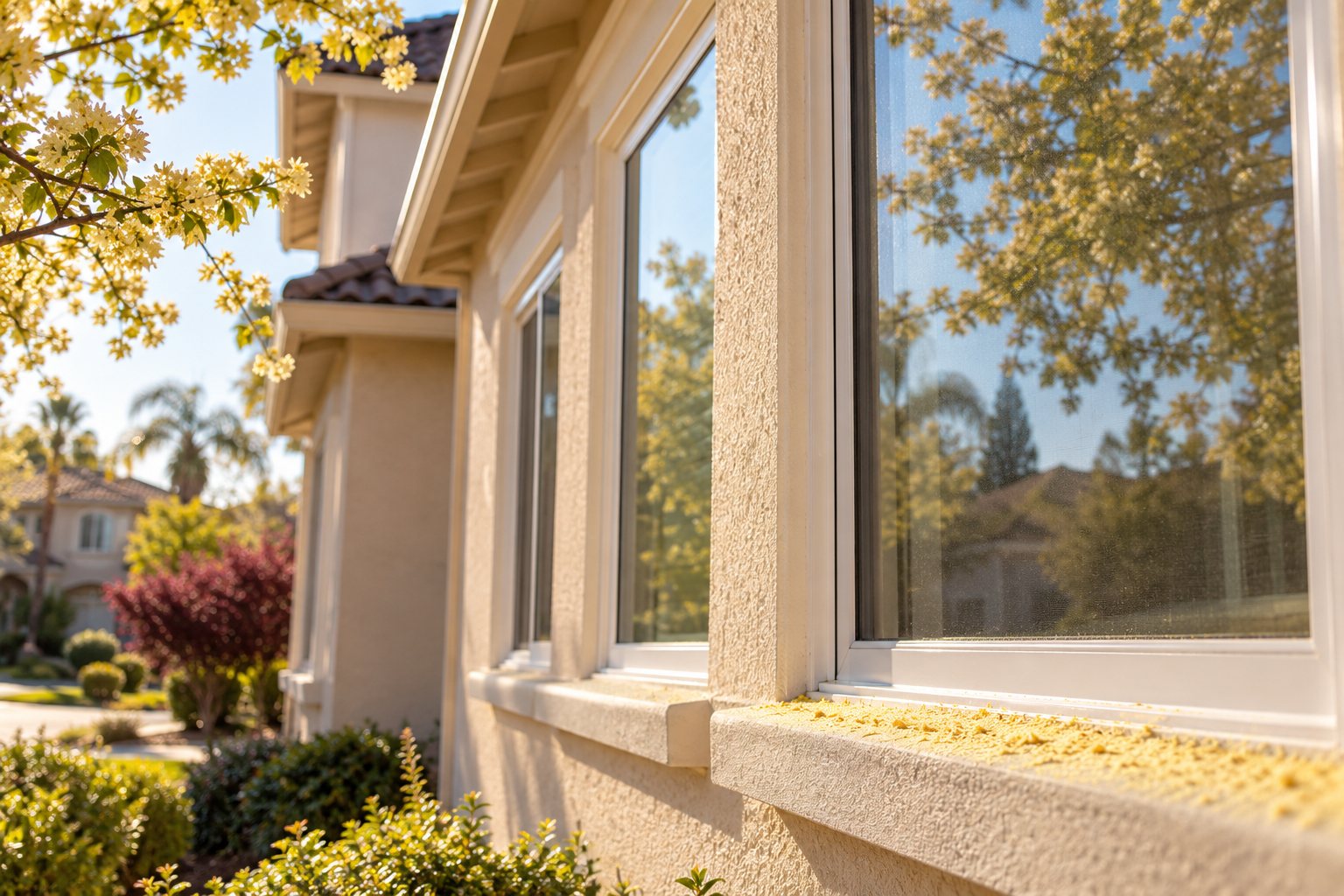
All tap and well water carries dissolved minerals. The U.S. Geological Survey explains that as water moves through soil and rock it dissolves small amounts of naturally occurring minerals, and that hardness is caused mainly by compounds of calcium and magnesium[1]. When a droplet sits on a window and evaporates, the water leaves but the minerals stay behind as a thin, chalky ring. Repeat that cycle every morning and the rings stack into a crusty film.
USGS classifies water by hardness measured as calcium carbonate[1]:
| Classification | Hardness (mg/L as calcium carbonate) |
|---|---|
| Soft | 0–60 |
| Moderately hard | 61–120 |
| Hard | 121–180 |
| Very hard | More than 180 |
How hard is the water around Sacramento?
It depends on your source. In its 2024 water quality report for the Central and South service areas, the Sacramento County Water Agency listed surface water at 47–62 mg/L total hardness, while groundwater ranged from 18 to as high as 220 mg/L[2]. In other words, some homes get fairly soft water and others, especially those on well-fed supplies, can be in the very hard range. Even soft water leaves some residue when it dries over and over on the same pane.
If you want your own number, Oregon State University Extension recommends simply asking your water supplier for its hardness figure, or testing if you are on a private well[3]. Most utilities publish it in their annual Consumer Confidence Report.
Common causes on home and business windows
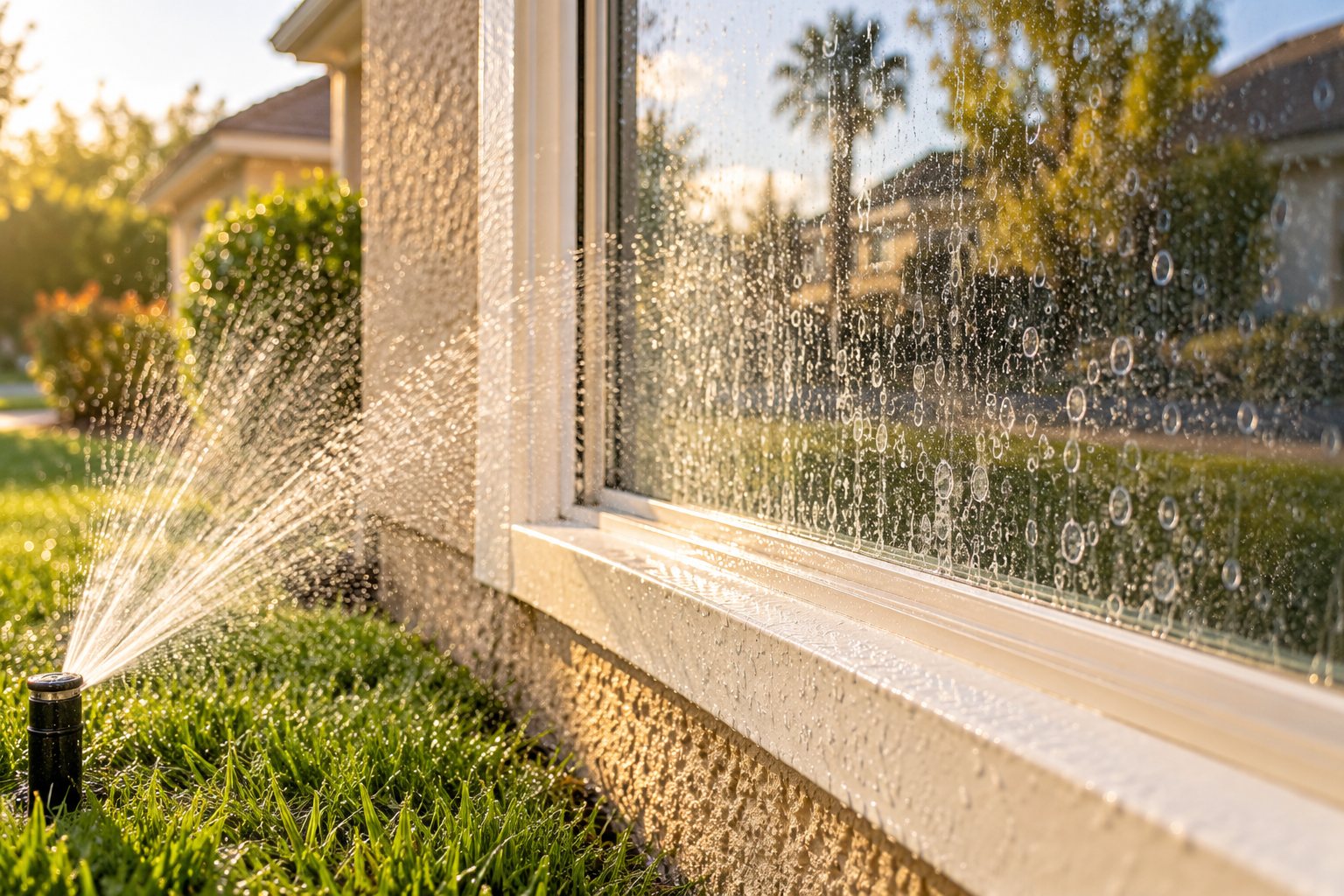
- Sprinkler overspray. This is the big one. Glass maker Pilkington notes that sprinklers near a building's perimeter can cause unwanted deposition of minerals, and because they may run daily, deposits can build up significantly[4].
- Hosing off dusty windows and letting them air-dry. Rinsing without drying leaves the same mineral rings as sprinklers.
- Runoff from above. Water dripping off eaves, trim or a balcony onto glass below.
- DIY washing in full sun. In a Central Valley summer, water can dry on hot glass before you can squeegee it.
Prevention: stop the water first
Cleaning spotted glass without fixing the source just resets the clock. Pilkington's guidance is to eliminate or minimize overspray on building surfaces, particularly glass, and to consider drip, underground or limited-pattern spray heads near the building[4]. Practical steps:
- Run your sprinklers for one cycle in daylight and watch which heads reach windows, doors and siding.
- Re-aim or adjust the arc of those heads, or swap them for lower-angle or limited-pattern nozzles.
- Convert beds right against the house to drip irrigation where practical.
- Avoid hosing windows and walking away. If you rinse, dry the glass with a squeegee or microfiber cloth.
- Check after any irrigation repair or new landscaping, since a single misaligned head can spot a whole wall.
Removal: start gentle, stay glass-safe
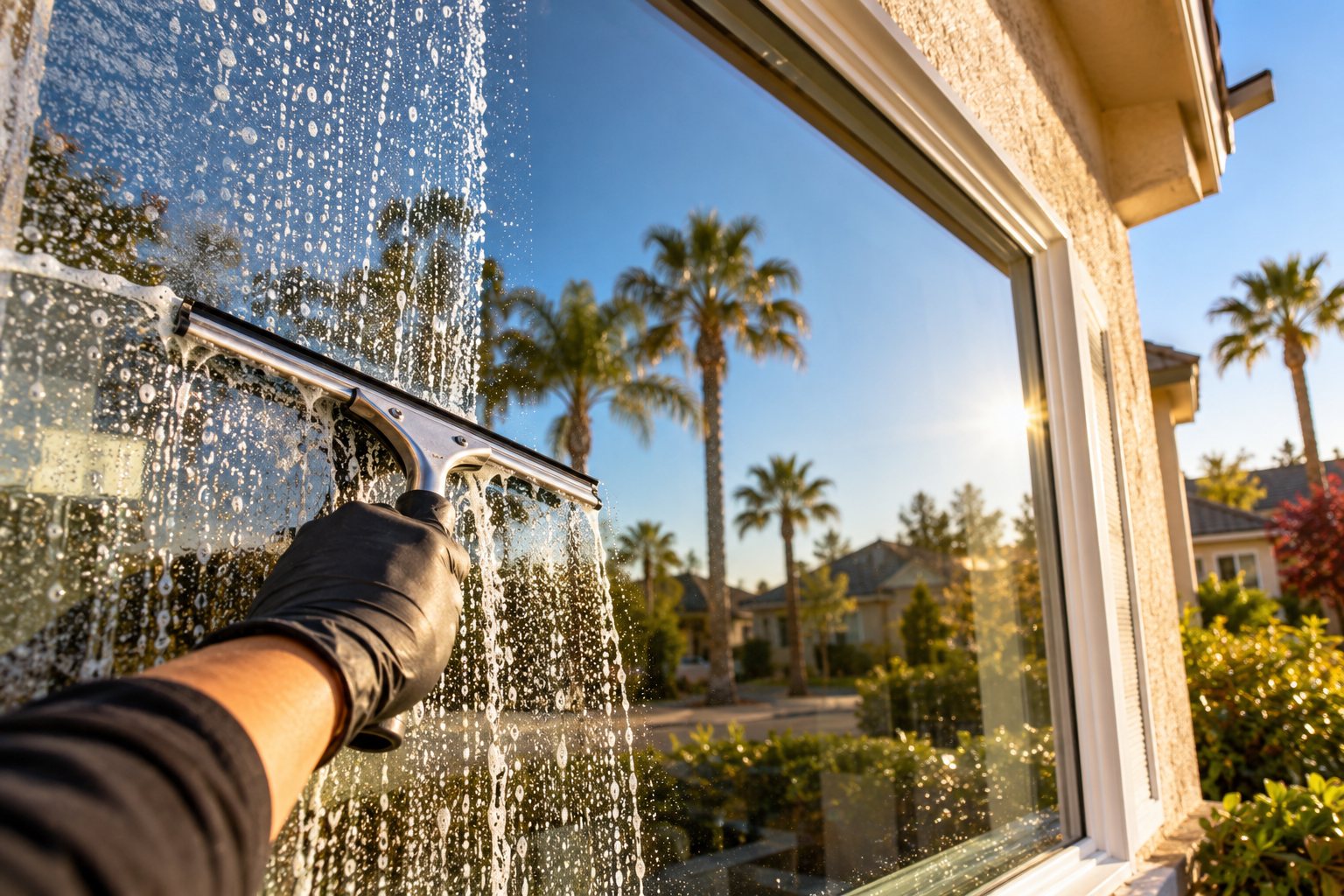
Light, fresh spots usually come off with ordinary window cleaning: wet the glass, scrub with a soft applicator, squeegee, and dry the edges. For slightly heavier film, a mild acid such as white vinegar helps loosen mineral deposits. The City of Scottsdale's hard water fact sheet, for example, recommends soaking fixtures in white vinegar to loosen deposits[5]. On windows, apply diluted vinegar, give it a few minutes to work, agitate with a soft pad, then rinse well and squeegee dry. Work in the shade so the solution doesn't dry on the glass, and keep it off nearby plants and finishes.
What to avoid matters as much as what to use. Pilkington warns that problems may occur when an abrasive or strong acid cleaner is used to remove deposits and that repeated action will ultimately damage the glass[4]. Skip steel wool, scouring powders, razor scraping on coated glass, and aggressive acid products unless you know the glass type and the product is approved for it.
Why waiting makes it worse
Pilkington describes dried mineral deposits as adhering quite well to smooth surfaces such as glass and being very difficult to remove[4]. In most cases the glass is not actually stained; it simply has a deposit on the surface. But the bulletin adds that if deposits build to the point where they stay damp and hold water against the glass for lengthy periods, staining or etching could be expected[4]. It also notes removal is even harder on glass with an exterior coating[4]. The takeaway: deal with spotting early, and as often as needed, rather than letting years of sprinkler cycles accumulate.
When to call a professional
If spots survive regular cleaning and a mild vinegar treatment, or you have coated or hard-to-reach glass, a professional exterior window cleaning is the safer route. LORS Cleaning cleans exterior glass, frames, sills and screens using eco-safe, biodegradable products. You get a free, exact estimate with no hidden fees, and if something isn't right, tell us within 24 hours and we'll come back and fix it free.
For more, see our Sacramento window cleaning guide and how often to clean windows in Sacramento. Sprinklers also stain concrete, so read walkway and patio cleaning for algae and our soft washing vs. pressure washing comparison for siding. We serve Sacramento, Roseville, Elk Grove and everywhere within 100 miles.
Quick answers
Does vinegar remove hard water spots from windows?
Diluted white vinegar can loosen light to moderate mineral spots. Let it sit a few minutes, agitate gently, rinse well and squeegee dry, working in the shade.
Can hard water spots damage glass?
Usually the deposit sits on the surface. A glass manufacturer warns that deposits kept damp against the glass for long periods, or repeated abrasive or strong-acid cleaning, can stain, etch or damage it.
How do I stop sprinkler spots from coming back?
Adjust or replace the heads that reach your windows, consider drip irrigation next to the house, and avoid letting hose water air-dry on glass.
Sources
- U.S. Geological Survey. Hardness of Water, Water Science School. https://www.usgs.gov/water-science-school/science/hardness-water
- Sacramento County Water Agency. 2024 Water Quality Report: Central & South Service Areas (2025). https://waterresources.saccounty.gov/scwa/Documents/CCR/2024/WQ%20CCR%20CSA-SSA%202024-062425.pdf
- Chernoh, E., Oregon State University Extension Service. White spots from watering with hard water? (2023). https://extension.oregonstate.edu/ask-extension/featured/white-spots-watering-hard-water
- Pilkington North America. Guidelines When Using Lawn Sprinklers, Technical Bulletin ATS-126 (2013). https://www.pilkington.com/-/media/pilkington/site-content/usa/window-manufacturers/technical-bulletins/ats126guidelineswhenusinglawnsprinklers20130116.pdf
- City of Scottsdale Water. Hard Water Fact Sheet. https://ww2.scottsdaleaz.gov/Assets/ScottsdaleAZ/Water/Water+Quality/hard-water-fact-sheet.pdf